
Thomas Harold Flowers MBE was an English engineer with the British General Post Office (GPO). During World War II, Flowers designed and built Colossus, the world’s first programmable electronic computer, to help decipher the encrypted messages sent by the German High Command.
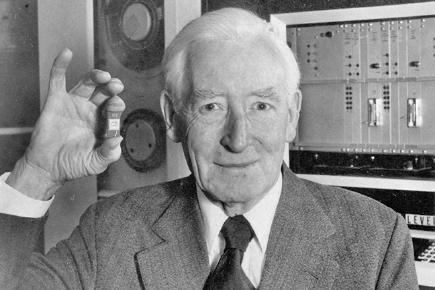
Tommy Flowers was born in Poplar, East London, in 1905, the son of a bricklayer. Unlike the academic elite at Bletchley Park who attended prestigious universities, Flowers developed his expertise through an apprenticeship at Woolwich Arsenal and pursued a BSc from London University through night-school courses while working. Joining the General Post Office (GPO) in 1926, he eventually moved to the research station at Dollis Hill, where he became a pioneer in electronic telephone switching. His “epiphany” occurred in 1937 when he realised that thermionic valves could be used as high-speed switches to perform complex digital logic, a concept far more advanced than the electromechanical relays used at the time.
During World War II, Flowers was summoned to Bletchley Park to assist with the “Tunny” code, a cipher used by the German High Command that was far more complex than the Enigma machine’s code worked on by Alan Turing. Despite facing class-based skepticism from university-educated mathematicians, Flowers designed and built Colossus, the world’s first semi-programmable electronic computer. Completed in just ten months, Colossus was a revolutionary machine that allowed the Allies to read the directives of Adolf Hitler and his generals in near real-time. This intelligence was crucial for the success of D-Day, as it confirmed the Germans had fallen for Allied deceptions and expected the invasion at Pas de Calais. Experts later calculated that Flowers’ work shortened the war by at least two years.
After the war, the work of Flower’s, his team of engineers, and the codebreakers, was kept secret for decades. Flowers returned to work at the GPO. While he continued to innovate, working on the ACE computer project and developing ERNIE for the Premium Bond draws, he had to watch as American computers like ENIAC received public acclaim for technology he had already mastered. Recognition finally came in the 1970s and 90s as the secrets of Bletchley Park were declassified; he was awarded an honorary doctorate and the Charles Babbage Medal before his death in 1998. Flowers’ transition from traditional switching to the electronic power of Colossus was, as one source describes, like moving from a World War I biplane to a rocket.
As part of our first National Lottery Heritage Fund project, we commissioned noted historian and author Giles MacDonogh to research and write a long-form piece on Tommy, with support from the Fensom and Flowers families, and The National Museum of Computing at Bletchley Park and GCHQ, who granted rare access to many Lorenz transcripts that Giles translated from German.