
By Giles MacDonogh.
It took the British authorities fifty years to declassify the wartime activities of the codebreakers of Bletchley Park, and in the last thirty, the full truth has come to light. We now know a good deal about the tragic figure of Alan Turing – he’s even on our banknotes – and the little gaggle of incredibly clever Cambridge and Oxford-educated boffins around him who, with the aid of sharpened pencils, an aptitude for chess, a knowledge of how to solve cryptic crossword puzzles and an electro-mechanical device called ‘Bombe’, cracked the Enigma cipher by which the German armed forces delivered reports and orders.
One of the most important members of the Bletchley team was Bill Tutte. After the war, Tutte was largely forgotten. He lived a quiet life teaching maths at a Canadian university. Nearly a quarter of a century after his death in 2002, Tutte was honoured by an appearance on our Victory in Europe stamps. For the rest a few MBEs, and OBEs were dangled. It was but a trifling reward for the importance of the work they had performed.
There have been several films: big, box-office numbers screened in cinemas together with lesser, but probably more accurate accounts made for television; not to mention stacks of books which have painted the work of these brilliant men and women in dramatic colours. They were people who truly shortened the length of the war and saved countless lives, but; do we actually know the full story? And have we given credit to the others, who came up with an even more revolutionary concept than ‘Bombe’, one which was to change our daily existence for ever: the programmable electronic computer? ‘The truth is rarely pure and never simple’ says Algernon in Oscar Wilde’s The Importance of Being Ernest.
Unrecognised Heroes
The cracking of the Enigma Codes was of huge importance. It allowed military planners to read the German Naval signals and curtail the sinking of merchant ships that brought vital supplies to the vulnerable British Isles. It was behind the encouraging British victories of El Alamein and Cape Matapan.
The first Enigma machines had appeared in the early twenties and were cracked by the Poles with their ‘Bomba’, the prototype for Turing’s ‘Bombe’. Of course they had been modified, to make decrypting more difficult, but there were faults and weaknesses that rapidly became apparent to codebreakers with a knowledge of the German language. ‘Cribs’ revealed certain combinations of letters that came up over and over again, comparing intercepts allowed them to piece together whole words that effectively rendered the code transparent. Once the codebreakers had worked out the alphabet, the Bombe could do the rest.
Enigma machines were used extensively throughout the war and even at quite low levels of command, but the most important signals were not sent via Enigma. They were issued using the Lorenz machines which the British called ‘Tunny’ or ‘Fish’. The code was much more complicated, and a great deal more difficult to break. The Lorenz machines could tell us what we wanted to know about the strategic decisions taken by OKW – German High Command. The codes could be painstakingly broken by hand, but this proved too slow. The codebreakers needed fast machines, and that was where electronics became vital for the first time.
The whizz-kids of electrical engineering were not to be found in universities then; they were chiefly restricted to the GPO (General Post Office) which had begun to experiment with electronic telephone switching just before the outbreak of war. Their research department in the unlikely surroundings of Dollis Hill in North-West London, was the only place in Britain able to construct an electronic programme operating at speeds capable of breaking ‘Tunny,’ thereby allowing the team to read the directives issued by Germany’s top brass almost in real time, and all the way up to Adolf Hitler himself.
The man chosen to head the GPO team that would build Colossus, the world’s first semi-programmable computer, was Tommy Flowers.
While it is not quite possible to say that the Bletchley boffins belonged to a social elite, there were both grammar and public-school products among them, most had either passed through, had interrupted their studies at, or were about to enter Britain’s top universities before they signed the Official Secrets Act and made their way to ‘Station X’. This was certainly not true of the men who put together Colossus. In most cases, if they had higher educational qualifications at all, these had been obtained at night-school.
Seconded to Bletchley, Cambridge don Max Newman commissioned electronic engineers to make a semi-electronic code-breaking machine that was rapidly baptised ‘Heath Robinson’ by the girls who operated it. Heath Robinson made some progress but it was cumbersome, inaccurate and still too slow. The first Colossus was reassembled at Bletchley Park at the beginning of 1944. It had taken ten months to construct. Its trial run was a moment of Damascene light. After that it churned out vital information, including the news that the Germans had swallowed the Allied feint and believed that the invasion which occurred on 6 June 1944 would come in the Pas de Calais, rather than on the beaches of Normandy. As a result, they failed to reinforce their armies on D-Day. Thousands of Allied lives were saved, and the operation marked the opening of the chapter that brought the war to an end.
The by now several Colossus machines were dismantled after the end of the war. Two of them were eventually packed off to the new GCHQ in Cheltenham. The Bletchley Park teams were dispersed back to their universities and research institutions. The Official Secrets Act meant they could not tell their stories. In the meantime, America claimed the invention of the first programmable electronic computer in 1946 with ENIAC, and even now Colossus is often passed over for its rightful place as the progenitor of modern computer technology.
From the mid-nineties, when the secrets of Bletchley Park were finally revealed, the stories of men such as Alan Turing, Bill Tutte, Max Newman, Jack Good and Donald Michie (Michie was just eighteen when he went to Bletchley) have been brought to light and the wider implications of the huge operation to break German, Italian and Japanese codes have been properly revealed; not just the boffins, but also the many more WRENs and ATS girls who fed and operated the machines in three punishing eight-hour shifts throughout the war. Bill Tutte is honoured by the Royal Mail, once upon a time an integral branch of the GPO, but it is the contribution made by Flowers and his team of electrical engineers at the GPO research station at Dollis Hill that remains unjustifiably neglected. And this is what this account sets out to correct for posterity.
From Poplar to Dollis Hill
Tommy Flowers was born in Poplar, in London’s East End on 22 December 1905. He was one of three children of a bricklayer. When he was still small, the family moved to East Ham, which was then properly in Essex. He had two sisters, one nine years older than him, the other nine years younger.
Flowers’ father may have been a bricklayer to begin with but he branched out, becoming a builder of bakers’ ovens all over England. Flowers described his father as a ‘craftsman.’ His sometime assistant Harry Fensom’s father was a cabinet maker-cum-joiner from nearby Stratford – also a skilled worker. Two of Flowers’ uncles were engineers: one an instrument-maker, the other worked for Vickers. Flowers’ talents were not quite such a flash in the pan as some have assumed. As a child he used his father’s tools to make himself a boat to sail on a local pond. He constructed windmills and trains out of Meccano, which he later harnessed to a steam engine. Between the wars many children became radio hams and had their own wireless sets, Fensom was one. His father made a crystal set complete with short-wave valves, receiver and microphone. It provided an early familiarity with radio beams and bandwidths, not to mention exotic places like Hilversum.
Flowers went to the local primary school and from there won a scholarship to the East End Technical College where he remained until he was sixteen. It appears to have been a progressive school, aiming to prepare children for careers in industry. He was top of the form in maths and sciences, he remembered maths, trigonometry, physics (where he learned about heat, light and sound) and geography classes but later confessed he was less good at English: ‘I can think but I can’t talk.’ His fellow cockney Fensom went to the local grammar and excelled in science and maths, learning all about electro-magnetism in physics. He left school at sixteen after taking the ‘Matric’ exam which absolved him of the need to take the Higher Certificate at eighteen. He had a telephone engineer uncle and applied to do the same. At his interview he could tell the board that he had made relays at home, Morse equipment, electrical switches and wireless sets.
Flowers was taught maths by a New Zealander who had been invalided out of the army after one of his arms was blown off by a shell. The school offered metalwork and woodwork. In the former he used a lathe and files and hatched plans to become an engineer, in the latter he made a box with a handle and used it as an attaché case to carry his kit. Flowers didn’t stay at school or apply for further education either – which would have proved too expensive for his and most other working-class households without obtaining one of the rare state scholarships offered from 1920 onwards. Instead, he was apprenticed at Woolwich Arsenal across the Thames, which was still at the centre of British military hardware production. In 1922, he enrolled in an intermediate engineering course at Woolwich Polytechnic, passing the exam in 1926.
The First World War had made an impression on him. Late in life he recalled a magazine he read called War Illustrated featuring Axis atrocities. In the house next door but one a boy was killed at the front. He remembered the Gotha bombers and Zeppelins flying over London and his mother leading the children down to the coal cellar (his father was away building a baker’s oven). He watched a Zeppelin caught in spotlights and shells bursting all around it in the night sky before it was brought down in flames. There was rationing, but they didn’t go hungry. There was always plenty of bread. When the Armistice came on 11 November 1918, the headmaster sent the children home. He roamed the streets, people were shouting.
In 1926, Flowers joined the Post Office. He was to remain there for the rest of his working life. There was a recruitment drive linked to the project to automate telephone exchanges, and he sat another tough, selective exam in maths, geometry, physics, geography and wrote an essay; he came top. For the following two years he trained to be an inspector in Islington. Much of the work involved testing new equipment as it came in: telephones, line equipment etc. After three months he was sent to the GPO building in King Edward Street in the City to work in the laboratory, where he studied circuits and signal transmission.
It might be hard to imagine now, but the GPO was a progressive institution, a government ministry with a famously avant-garde film unit that ran from 1933 to 1940 under John Grierson. It produced government propaganda using famous poets and musicians. Emitting and intercepting radio signals had become important in the First World War, and in the thirties, the GPO was to play a prominent part in developing radar. It had also used commercial codes and continued to be responsible for laying new cables, listening in when called upon to do so. In the First World War the German cables were cut, forcing the Germans onto the air-waves and to transmit messages by Morse. They were easier to intercept that way, so the messages were encoded, and the Admiralty hired brains to unlock their secrets.
The GPO still supplied radio crystals to the Admiralty and the War Office. In 1924, it was employing 38 qualified engineers, most of whom had started out as apprentices and possessed a research station that trained them for special projects. When Colossus was launched in 1943, it was one of nineteen. The GPO at Dollis Hill shared the stage with the National Physical Laboratory (NPL) and the Telecommunications Research Establishment (TRE) in Malvern. There were academic institutions as well such as the Cavendish Laboratory at Cambridge and the Clarendon at Oxford but their work was much more theoretical.
Flowers also enrolled in an evening class at the Northampton Institute in St John Street (now part of the City University) which provided appropriate courses for telephone engineers. He worked under the lab director F I Ray, a ‘workaholic’ who ‘expected us all to be workaholics.’ Flowers found this far more instructive than what he was learning at the Post Office. There were some ex-army signals people there. He characterised their knowledge as ‘very elementary’; ‘they knew practice and I knew theory’ he said. Fensom trained to be an engineer by doing City and Guild exams at Borough Polytechnic Institute, ancestor to the South Bank University. Work and study made for a long day. He started at 7.45 am and got home at 10.00 pm.
Colleges like the Northampton Institute or Borough Polytechnic provided practical professional education in a way that traditional universities did not. To some extent they held a monopoly on this until they were merged with the universities under John Major’s 1992 reforms. Universities were meant to exercise the mind. How you applied your knowledge professionally was not their affair. Flowers was to come face to face with this dichotomy when he was sent up to Bletchley Park. There he met brilliant theoretical mathematicians who had not the foggiest idea of electronics. It took Flowers to show them how electronics could solve their biggest problem. R V Jones, writing about his time as intelligence officer at the wartime Air Ministry, reveals that there were just six fellowships teaching physics among the two dozen undergraduate colleges then at Oxford.
The two education systems could both terminate in degrees. Some night-school students aspired to take London University BScs through their colleges, as Flowers was to do in 1933. His boss at the Post Office, Gordon Radley went one further and took a DSc.
At the lab in King Edward Street, Tommy and his fellow technicians created their own equipment: relays, dials and tested parts that other parts couldn’t reach. They were unaware that telephone circuits would become the forerunners to computer programmes. By fully electrifying telephone circuits, they uncovered the technology that would not only speed up the assessment of statistical research, it would prove vital to wartime codebreaking.
Electromagnetic switches replaced the plugboard connections we see in old films, they were essentially binary: on or off. In Flowers’ time at the Post Office, exchanges went over to a system whereby you dialled up an exchange (three numbers) and then a four-figure subscriber number and were automatically connected. This remained much the same system until digital technology was introduced. A single exchange could manage 20,000 subscribers, but the problem came with automating long-distance dialling. That was solved by the use of thermionic valves and amplifiers. The self-same valves that were later to solve the problems at Bletchley.
Flowers understood that the Post Office needed to embrace digital logic. He discovered electronic counting circuits from a 1937 article by the Cambridge physicist Wilfred Bennet-Lewis: A ‘Scale-of-two’ High Speed Counter Using Hard Vacuum Triodes.’ It was his epiphany. Flowers learned that digital electronics could do more than just count – it could perform logic (Boolean operations) assessing whether a mathematical condition was true or false and taking action accordingly. You could make an electronic equivalent to any electro-magnetic switching or data processing machine.
Switching was a binary function, on or off, 0 or 1. This was to open a new world to Flowers which would, once again, become increasingly important when it came to cracking German codes, but Flowers was adamant that no one spoke about computers then or invoke the pioneer Babbage: ‘computers hadn’t been thought of.’ In technical parlance then, a computer was a counting machine, nothing more. Even at Cambridge it wasn’t until the mid-thirties that Alan Turing turned his mind to the potential of computers, and the paper he wrote on the subject was very much in the domain of theory.
The young post office engineers were all keen to get on. They not only did their night-school courses but they took their work home with them. Describing the situation shortly before his death, Flowers populated the place with ‘workaholics,’ admitting that he was one too. He was transferred to the Research Department in Dollis Hill in 1930. It was housed in army huts then, but a new, neo-Georgian building was inaugurated by the prime minister, Ramsey MacDonald in 1933. Here Flowers continued to work on the automatic switching that was to revolutionise the network. The lynchpin was the introduction of valves, Flowers’ claim to fame. Flowers wasn’t the only person to see the importance of valves. A private company had anticipated him by a couple of years, but he was unaware of this. The value of a thermionic valve lay in its use as a super-fast switch controlled by the rapidity of electronic pulses, another binary system where a pulse equalled 1, and no pulse was zero or off. He didn’t know it at the time, but he was starting out on the road to digital electronics. In 1934, Flowers wired up an experimental installation using between 3,000 and 4,000 valves to control telephone connections. This was the network planned by the GPO from 1939 and initiated at Highgate Wood, the first all-electronic exchange in Europe after the war.
Long-distance dialling was another problem. Flowers found the solution with his beloved valves which could be used to carry speech, the pulses strengthened by amplifiers. The GPO gave him two circuits and he experimented with AC 600 – 900 cycles per second from London to Bristol, where he was able to speak to his future wife on the telephone. Long-distance dialling proved a success. During the war local calls were made difficult by extensive military use and the evacuation of exchange staff, but long-distance calls were not affected.
Travels to Germany
In 1922, the League of Nations had created a committee to coordinate European telephone networks. Flowers was made a member in 1939. International dialling was in its infancy then. The Dutch had a similar system, while the Swiss had theirs up and running two years before Britain. Although he was fairly senior by then, he was not well paid compared to those who worked in industry, but he didn’t wish to move out of London. His seniors were often anxious to take the credit for innovations hatched in the building when it came to transmitters and receivers. Flowers found his boss Radley sympathetic. He too worked hard. He was a ‘warped genius,’ religious, he didn’t like flippancy. ‘Never has there been a time’ pronounced Radley, ‘when so many knew so little about so much.’ However, you had to be very careful not to upset him. He was also mean.
Flowers took his holidays in Germany in the early thirties. He was aware of Hitler’s persecution of the Jews. Flowers was not too worried about being called up. He knew his work was of ‘national importance.’ Later in the war Dollis Hill was officially named a ‘military establishment.’ As it was, he was very nearly marooned in Germany for the course of the war. In September 1939, just days before the war began, he was in Berlin as a delegate for the International Committee of European Telephones. The conference was due to start on the 9th. Arrangements were made for the British Embassy to inform delegates should the situation become difficult, which it promptly did. The following day there was a message from the embassy telling them to take the next available train. They had two hours to pack up and dash for the coast. Late in life Flowers remembered the deserted stations. They reached Holland after dark, where the army was mobilising, the Belgians too. Flowers arrived at Liverpool Street at eight the next morning. Near the station he saw a bank opening and changed his Marks into sterling. The frontiers closed at 11.00 when diplomatic relations were suspended. Banks would no longer exchange Marks.
Flowers believed the Second World War would be worse than the First, but he could concentrate on vital war-work. Until February 1943, this meant radar (or ‘radio detection and ranging’) and tracking in-coming aircraft as well as communicating the information to Fighter Command at Stanmore, where he was frequently obliged to report in person. Flowers provided switching for the remote on/off switches. He was not involved in bugging, which was also a role assumed by the GPO. It was they who listened into the conversations of German prisoners in the Tower. Dollis Hill played another wartime role, largely forgotten now, it housed a set of subterranean rooms for the Cabinet should aerial attack render Central London too dangerous. These 59 Cabinet War Rooms still exist. They were called ‘the Paddock.’ Churchill apparently loathed them and the Cabinet only met there twice: on 3 August 1940 (a day when the RAF suffered huge losses) and 10 March 1941 (the date of the destruction of Portsmouth). The Paddock was one of three such secret installations: the Admiralty had one in Cricklewood, the Air Ministry’s was under the HMSO building in Harrow.
At the time Britain was beginning to break the Enigma codes. At the start of the war, MI6 had decamped to Bletchley Park adjacent to what is now Milton Keynes, about fifty miles north of London and more or less equidistant from Oxford and Cambridge. Henceforth Bletchley would be ‘Station X’. The Jacobethan country house, together with its outbuildings and a collection of jerry-built huts rapidly acquired a gaggle of eccentric inmates, some of whom had been breaking codes since the Great War and the halcyon days of Admiralty Room 40. After the First World War the department was renamed the GC & CS (Government Code and Cipher School) the ancestor of GCHQ. One was Dillwyn ‘Dilly’ Knox, who worked with his assistant Mavis Lever (later Batey) and an all-female team, who had been able to tip off the Royal Navy that the Italians were planning an attack in the Eastern Mediterranean. As a result, the navy turned the tables on the Italians at the Battle of Matapan on 28 March 1941. Churchill called it ‘the greatest sea fight since Trafalgar.’ Dilly taunted the Italians with a rhyme:
These have knelled your fall and ruin
But your ears were far away
English lassies rustling papers
Through the sodden Bletchley day.
His fellow cryptographer William ‘Nobby’ Clarke capped this:
By the grace of God and Dilly,
He was the brains behind them all
And should never be forgotten. Will he?
Dilly was one of Bletchley’s stars. It was he who cracked the Abwehr – German military intelligence – codes. He liked to do his thinking in a hot bath. Fortunately, his ‘cottage’ at Bletchley came with proper plumbing. Another was Max Newman, an absent-minded Cambridge don who was once rescued by a Wren on Bletchley station wearing a Burberry coat and clutching a dead hare by its hind legs. He was searching the platform for something, which turned out to be a lost ticket. The Wren assured him that the guard would trust him without one. Newman replied ‘Oh no, that is not my problem – until I find my ticket, I cannot remember whether I am going to Oxford or Cambridge!’
The Enigma encrypting machine (never a computer) was first broken by a Polish team, but the designers made it harder to crack by adding further complexities: first scrambling wheels then a plug-board. Turing’s ‘bombes’ cracked it first in 1941, at much the same time as Knox. Most ciphers were ‘hand-broken’ quite pragmatically. As the 1945 General Report on Tunny put it, ‘several equations of the form are soluble given streams of sufficient length. In some cases, the solution is a job for a linguist, in others for [a] statistician, and mechanical aid may not be required.’ Codebreakers worked with ‘cribs’: recurring lapidary phrases that could be picked out from the cipher such as ‘keine besondere Ereignisse’ (no noteworthy events). Fifteen characters would reveal the setting of the right-hand wheel while180 characters would expose both the workings of the right and middle wheels.
A letter cipher generally provided plenty of leads: letters are not equal. In English, for example, E represents 12% of the alphabet, T 9%, A, T and O 8%, I, N and S 7%, R 6%, while J, K, X Q and Z were all under 1%. This rather dented the simple calculation there were 26 x 26 combinations: there weren’t; you never see the combination of HH, II, JJ, KK, QQ, WW, XX or YY. Vowels are rarely mixed; N was not preceded by a consonant (except K); there is EA, but seldom AE, LM but not ML, RN, not NR. Expert linguist staff could provide the same surveys in German, Italian or Japanese.
Enigma required three men to send a message and three to receive it: one pressed the keys, and read out the new encrypted letter which a second man copied out. When the message was finished, it was given to a third man to deliver it by Morse. At the other end the process was carried out in reverse. Codebreakers soon had their favourite methods: ‘Banburismus’ was applying sheets of paper (manufactured in Banbury) with punched holes representing each mapped signal to spot a giveaway phrase. ‘Cribsters’ and ‘Banburists’ represented two different schools. ‘Depths’ were resent messages allowing cryptographers to study small variations for clues, or predictable phrases culled from weather forecasts etc. In SS messages, for example, Heinrich Himmler always insisted on full name and rank. Hunches were classified under the pig-German term of ‘Turingismus.’
Knox’s colleague Brigadier John Tiltman was a natural codebreaker with no higher education let alone knowledge of Boolean logic or statistics. On the other hand, he had learned Russian, German and Japanese and was able to break the German Police cipher and read the news of the first mass slaughters of Jews following Operation Barbarossa in the summer of 1941. There were 30,000 dead by 7 August. Some branches of the German armed forces were easier to crack than others.
A clash of cultures
As early as March 1940, Edward Travis, who was to replace the veteran Alistair Denniston as head of the GC & CS at Bletchley Park, had asked the GPO for help with the newly modified four-wheel Enigma machine which had replaced the earlier three-wheel model broken by Turing. The bombes needed speeding up. Radley had visited Bletchley on 24 February and was critical of the GC & CS for not requesting help earlier. Flowers was summoned and interviewed by Travis and Turing who explained codebreaking to him. Turing needed a machine to determine the starting position of the code wheels, something ATS girls could operate with the keyboard of a typewriter. Turing knew Flowers was the expert on relays and he wanted a relay-based decoding machine for Enigma. Flowers remembered Turing’s stammer later: ‘He impressed me as a character (he) had a stammer when he got excited.’ ‘Sometimes you had to listen very carefully and integrate several sentences before you knew what he was talking about… He was very coherent as far as we were concerned.’ For Flowers, Turing was the man who had defeated the U-Boats.
Flowers advised adapting Bombe with a commutator to change the direction of the electric current, together with an electric valve sensing unit. He made a machine, but it was never used. ‘I think they thought I wasn’t very good… I didn’t get any work from Bletchley after that.’ Turing was actually impressed by Flowers and recommended him to his old Cambridge supervisor Newman. The commutator was built by C E Wynn-Williams at TRE using the thyratron gas valve-based calculator he had built at Cambridge, while the sensing unit was made by Harold ‘Doc’ Keen of British Tabulating Machines which had produced the bombe for Turing and Welchman. Bletchley was critical of Radley, whom they accused of ‘acting like a salesman’ by pushing Flowers forward. The feeling was mutual. As for Flowers, he said he was not offended and didn’t give the matter much thought.
The machine was called ‘Analyser’ and was used to test Enigma messages after the settings had been revealed by Turing’s Bombe. Tabulating data-storage machines were the invention of Hermann Hollerith, a German immigrant to the US who created punched cards which could be read by electromagnetic machines. The Analyser filled an entire room, but Bletchley was not impressed and it was scrapped. A ‘Tabulator’ designed by Flowers, Sydney Broadhurst and William Chandler was similarly spurned. Next up to deal with the added fourth wheel on the German naval Enigma, was the purely electronic ‘Cobra’ designed by Wynn-Williams. It was found to be unreliable. There were also three types of coding machines. Bletchley demonstrated a quasi-insatiable need for hardware. Another machine was called ‘Mrs Miles,’ which had four tape-reading leads, a reference to a Mrs Miles in St Neots, who had famously given birth to quads.
Gordon Welchman laid into Flowers. In a letter to Denniston, Welchman wrote ‘Dr Wynn-Williams has found it difficult to get on with the Dollis Hill people, and feels that Mr Flowers’ idea of co-operation is to run things himself.’ ‘[Flowers] was probably very good at his ordinary work, and also very good at designing apparatus for a definite problem that he understood … [and believing this task beyond his capabilities] I have found him very slow at grasping the complications of our work and his mind seems to be altogether inflexible.’
Mair Russell-Jones, who worked under Welchman, pointed out his snobbery towards Flowers with his East London accent. ‘He hadn’t been to university.’ She recalled ‘This is the only instance of class prejudice I can remember in Bletchley Park.’ Flowers spoke his mind. He was friendly to his team but there was a violent outburst toward the British Tabulating Company whose machine he said was ‘badly designed.’ He rejected Welchman’s insistence on ‘using relays at all costs.’
The issue caused bad blood. The GPO was critical of British Tabulating Machines and Welchman argued against using the GPO. Flowers had come face to face with the collegiate world of British universities, possibly for the first time. By no means all the codebreakers at Bletchley were educated at Cambridge or Oxford, but most of the top people were. The old lags were generally classicists, but at the beginning of the war there was a wave of mathematicians (mostly from Cambridge) and there were many linguists too: someone had to translate the plaintext once the code was broken. As Rachel Boon has pointed out ‘Bletchley Park operated on a hierarchy correlating to academic aptitude, which meant that senior staff were less likely to have dealt with engineers as equals. With Dollis Hill being predominantly engineers many of whom had started their technical training as apprentices, they were less used to working with academics from different social or educational backgrounds.’
Some of the luminaries of Bletchley, Bill Tutte for example, came from backgrounds as humble as Flowers’ (his father was a Newmarket gardener), but Tutte had won both a state scholarship and a college scholarship to Trinity College Cambridge. He had experienced the interaction with other clever undergraduates in tutorials, combination rooms, dining halls and sports fields. Engineers like Flowers had seen little of this conviviality beavering away in their laboratories at night to achieve their qualifications. Some of the university men were not snooty towards the engineers, Turing was a case in point, and the mathematician Newman took trouble to teach Fensom numbers and probability. These worlds represented two circles in a Venn diagram that hardly overlapped.
On 4 August 1942, Fensom joined the team in Dollis Hill armed with a bar of soap and a towel. He was taken to Flowers at switching and signalling systems. Five or six people served in the team then, a further nine joined the following week. They worked very hard but Flowers looked after his men with occasional nights out when they went to a restaurant and the theatre. A week later Fensom was summoned to see Radley. By this time, he realised he was working on a machine for encrypting messages: he had seen relay panels in groups of twenty-six. Radley made him sign the Official Secrets Act.
The Lorenz code challenge
Flowers did get more work from Bletchley. In June 1941, a new music was heard over the air-waves. It was not Morse but ‘Tunny’ or ‘Fish,’ the new Lorenz SZ40 or SZ42A and SZ42B cipher, which required two whole lorries to carry its equipment, one to send, the other to receive. It was based not on alphabetical codes, like Enigma, but on the binary language of the teleprinter cipher. Lorenz, wrote Flowers, ‘was a great advance on Enigma. Enigma was slow to encode and slow to decode.’ Teleprinter codes such as Baudot-Murray were known, international languages emitted in the form of patterns of electrical pulses. Codebreakers were obliged to learn them. Each character was a binary combination of five pulses and absent pulses. To maintain secrecy, the machines were equipped with twelve wheels looking like ‘plates in a rack’ (Jack Copeland) which scrambled the teleprinter code. The keys were divided into four χ (the Greek letter ‘chi’), four ψ (the Greek letter ‘psi’) and two μ (the Greek letter ‘mu’) settings. ‘Chi’ was not quite what it seemed: it was short for ‘chiffre’, the French and German term for a secret code. Naturally the classicists made it look like Greek and added Greek letters for the other wheels. The χ-wheel was the key, break that and the code fell apart. You only needed to ‘de-chi!’
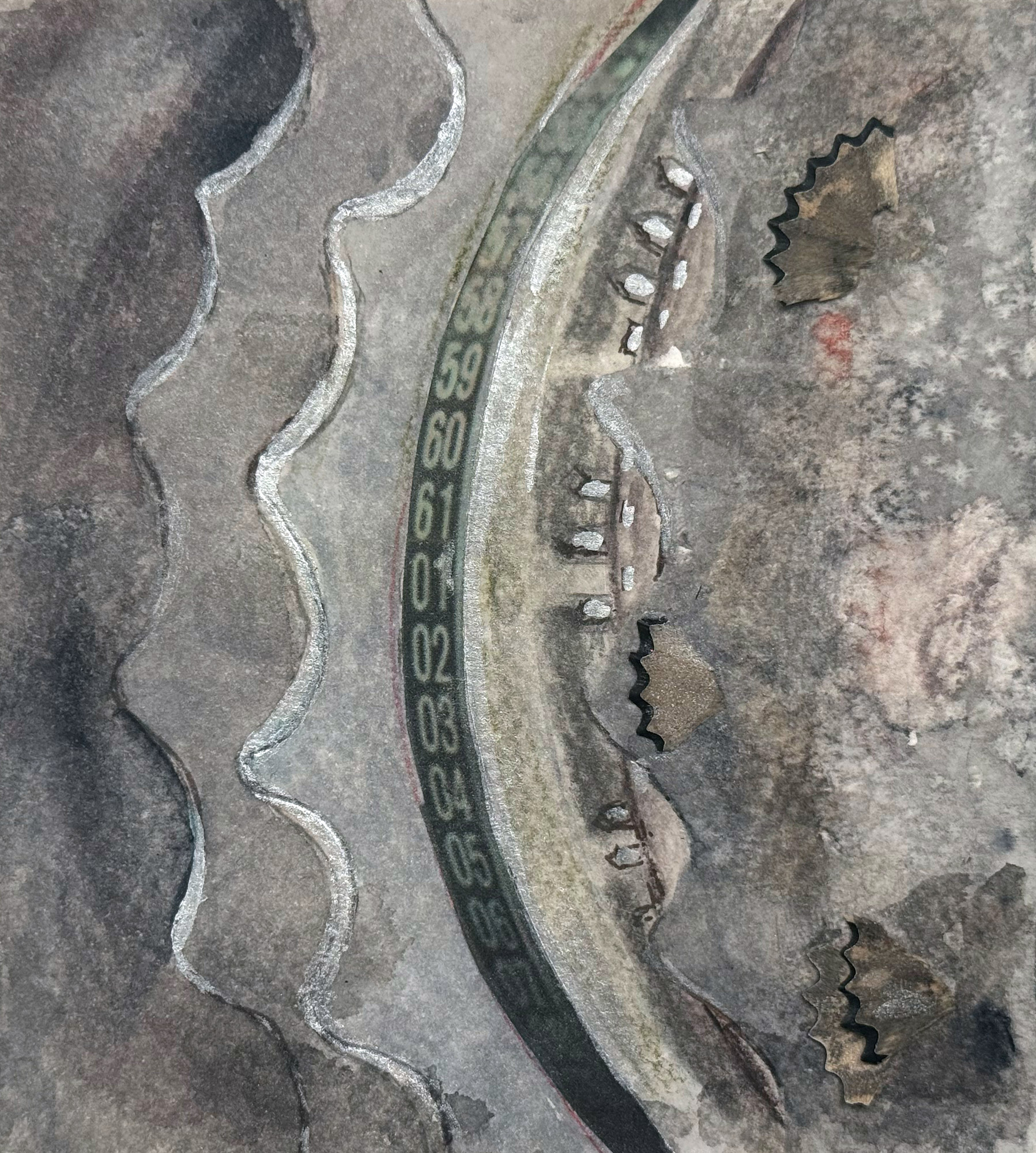
Cams were pins generating electric pulses. You typed the message into the teleprinter or fed in a tape and the pulses passed to the transmitter. ‘Tunny’ then masked the plaintext with a stream of obscuring letters produced by the wheels. They didn’t set every time, only when the motor wheels told them to set. The receiver’s machine took the pulses and stripped off the key to reveal the plaintext. It was then printed out on sticky paper like a telegram or punched onto a tape.
To some extent the riddle was solved by Bill Tutte, who instituted the statistical method by counting dots to work out the χ settings. You looked for the highest score, but the method required more speed than hand breakers could guarantee to determine the setting positions of the code-wheels. The Germans made some careless mistakes, however, someone sent an incomprehensible message which no one could understand and so it was sent again ‘en clair’, but in those early days, ‘Tunny’, or ‘Fish’ was easier to break. New settings remained a challenge until in January 1942 ‘crossword-solver’ Tiltman was able to deduce the full structure of Tunny from 4,000 letters of key, when the same message was resent. It contained minor variations, such as the word ‘SPRUCHNUMMER,’ spelled out in one, abbreviated in the other, as well as some misspellings and changes in spacing. Comparing the two provided a depth revealing wheel-settings and plaintext. As Stephen Budiansky says, it was a ‘gift from heaven.’
The German planning for the Battle of Kursk was hand-broken by using depths (cribs culled from comparing two similar messages using the same wheel-settings). The government was able to warn the Soviets (who were also being tipped off by the ‘Fifth Man’, John Cairncross, who was at Bletchley at the time). There was a two-stage process that eventually resulted in the creation of the Newmanry under Max Newman in December 1943 to compliment the Testery under Ralph Tester. The Newmanry unlocked the χ -wheel-settings and delivered the message to the Testery where it was unravelled and translated and issued as ‘Ultra’. Jerry Roberts calculated that the Testery did over three-quarters of the work of breaking some 64,000 top-level German messages. The codebreakers in the Testery had to do the work in their heads, which meant memorising the 1024 five-bit additions table. The wiring of the Lorenz was unravelled by 1 February 1942. From July, nearly every transmission was read in the Testery.
The centre of transmission was Strausberg, thirty kilometres east of Berlin. It linked up with Germany’s main command centres all over occupied Europe. These links were codified in Bletchley Park with the names of different fishes. At first the wheel settings had been selected by the sender. In theory, they had always to be different but some operators were lazy and sent two messages with the same wheel-settings, thereby laying them open to the creation of a depth. They also sent short messages en clair, revealing even more information to the codebreakers. The wheel-settings were HQIBPEXEZMUG which were often represented by names such as Anton, Berta or Caesar. In October, however, the Germans altered the codes and the twelve-letter preamble was scrapped, removing valuable information. It was ‘a black day’. Now German encryptors referred to the QEP, a book in which a hundred or more wheel-settings had been written down. The days of cribs were over.
The epiphany of electronic logic
Both the transmitter and the receiver had the book and replacements were issued when all the codes had been used up. From October 1942, QEP meant that Tutte’s breakage was no longer applicable. The team was thrown back on very slow analysis. Newman summoned Flowers who understood immediately that he needed a processor that was a hundred times faster than bombe. He had the solution: thermionic valves to turn the switches on and off. They were 1,000-times faster than relays, the same valves as you found in radios, but in radios they did not function as switches. This was the origin of digital electronics. It was a lucky accident that Dollis Hill had experience in this. Bletchley Park didn’t know that Flowers had already done the research and consequently plumped for the hybrid Heath Robinson.
Flowers said the abstract mathematician Newman had ‘no idea of machinery… he wanted a machine (but) instead of giving me the job, which I think he should have done… they gave the job to a Welshman (sic – he meant Wynn-Williams of TRE). He was a Cambridge scientist.’ Newman did know that his machine needed to be able to count holes. Wynn-Williams’ design could count impulses in a paper tape reader with an electric eye. He had invented a particle counter powered by electronic valves at Cambridge. The valves lit up like neon tubes. When it was positive a blue light showed. If there was no light it was negative. Now he produced a design and handed it to Frank Morrell, head of the Telegraph and Teleprinter Group at Dollis Hill, to produce.
This was ‘Heath Robinson’, mostly powered by relays, but with some valves. Flowers was there for the inauguration in Hut 11. He acknowledged that the machine wasn’t a complete failure, but it was unwieldy and involved two teleprinter tapes rotating in sync on sprocket wheels (the ‘bedstead’). ‘One run could take several hours… the paper tape tore. That was hopeless. Then they gave the problem to me.’ Indeed, Turing had suggested Newman approach Flowers. Newman blessed both projects but he wanted something quickly that could deal with the proliferation of Tunny traffic. Wynn-Williams meanwhile advised the Foreign Office against Flowers. This was reported to Radley who told Flowers to proceed even if he had not received the go-ahead from Bletchley.
Flowers was gracious: Heath Robinson was ‘unreliable’. If you ran it twice it was likely to give you two different answers. Once again, the way forward lay in valves: valve switching was the only way to reach the required speeds. Robinson was capable of revealing the settings in the χ wheels, which gave the cryptographers a head start: ‘A stretch of de-χ (Δ) [the results of breaking the χ-wheel settings] can be converted by eye into the sum of P [plaintext], and ψ by a skilled cryptographer with knowledge of ‘Tunny German’ and the power of instantaneous mental addition of letters of the teleprinter alphabet’ (General Report). Z + χ = P + ψ, the cipher (Z) combined with chi, was the same as the plaintext (P) combined with psi. Again, all you had to do was to remove chi! Once ‘de-chi’d’ the message could be fed into the Tunny replica machines to print out the plain text. Later versions of Heath Robinson were better, but still not great. Jack Good claimed you could detect a fault by the way it smelled, or the noise it made.
Colossus: the birth of digital computing
The significance of tunny traffic, wrote Sir Harry Hinsley, ‘was so exceptional, so strategic, that they lost nothing of their intelligence value from the fact that, whereas Enigma was decrypted nearly currently, Fish transmissions were individually so troublesome, and even with the aid of the decrypting machinery, they were usually decrypted with a delay of several days.’ The only way that the massive influx of data could be sorted out was by radically speeding up the process. Flowers knew that it had to be fully electronic. He wanted between 1,000 and 2,000 valves. Both TRE and Bletchley Park were incredulous. Radley understood what Flowers needed and provided staff, although his parsimony came to the fore and Flowers ended up having to pay for some of the material out of his own pocket. Radley fought hard for Colossus and after the quasi-failure of Heath Robinson it finally got the go-ahead in February 1943 when Flowers was awarded the MBE, the first and last honour he was ever to achieve.
Flowers was sceptical at first because he thought it would take too long to build. The design was all his but he was helped in Network Switching by the former labourer Sid Broadhurst and Bill Chandler, who’d been at the GPO since 1936. Newman had specified the algorithm. Turing played no part himself. Flowers had a team of around fifty to build Colossus. ‘There were lab staff plus workers in the Post Office factory to make the things we couldn’t make.’ The factory made the racks and wiring. The job was huge. They had to assemble masses of components, get all the circuits to work in sync and Colossus needed to be flexible and multi-applicable. Flowers required a reader for photoelectric cells and had to create a printer. He decided to base it on the IBM electric typewriter – to be controlled by Colossus. Bennet-Lewis’s counter didn’t help; Flowers wanted something like a telephone switch.
Newman’s team was desperate for something to bolster morale in Hut 8. He brought in another Cambridge mathematician, Dr Jack Good, and the youthful Donald Michie from Hut 11 to add to a staff of twenty-eight (five cryptographers, seven engineers and sixteen Wrens). The Wynn-Williams and Morrell electromagnetic machine was installed in June. It emitted smoke and whirred like a car, tore up tapes and was notably slow and inaccurate. It did little to restore morale. Good and Michie were more generous about Heath-Robinson, feeding it data during nighttime sessions. It handled two or three messages a week, a tenth of the total.
Flowers’ design was finished by the spring of 1943 and was taken to Dollis Hill. He had drawn a rough diagram of the system and tore it into parts, distributing them to the group. ‘Doc’ Coombs wrote ‘my mind, my horizon, my whole universe was full of valves switching on and off.’ Colossus proved its worth with an entire ‘armoury’ to make it work: repeater exchanges of the wideband carrier transmission system, radio and radar and television. All this came together in one machine for the first time. Digital logic for processing would replace the two tapes with electronics. The master control would decide whether to take one action or another based on the settings. Another machine would print the results.
Chandler had designed a cathode-ray oscilloscope which could display wave forms of low voltages, ideal for studying the behaviour of the logic circuits and monitoring the valves’ electrodes without disturbing them. The thyratrons formed a continuous ring like a clock face with each one lighting up for a time while they counted characters. Fensom summed up the advantages of Colossus: ‘Only one tape (as opposed to two on Heath Robinson), was run over the bedstead, driven now by friction only, since the sprocket wheels were no longer needed to keep the two tapes in step. This gave two advantages: the tape didn’t wear out and it could be driven at nearly three times the speed. In fact, at 5,000 characters per second, this is about 30 mph, through the lamp gate (or reader). No other reader was able to reach this speed until about twenty years later and of course we had to keep it a secret.’ They had been, according to American writer David A Price, ‘birthing the digital age.’
Colossus was assembled at Dollis Hill on 8 December 1943. It had been completed in ten months. Flowers had initially thought it would take three to five years. They had worked twelve hours a day and six-and-a-half days a week. Once the machine was seen to work properly, it was deconstructed and mounted on a lorry to be taken to Bletchley. On 18 January, Fensom took it to Block F to be erected close to Heath Robinson and its newer version, Old Robinson. Two more Robinsons were built by Flowers. Fensom was on hand to set it up. At its full extent, Colossus was seven foot high and 12 foot wide. The first trial took place on 5 February. ‘We were able to present it to Max Newman,’ wrote Fensom. ‘The programme was fed in, after ten minutes it was completed, it was repeated several times and the same action occurred every time. Most important, perhaps, it could store the Fish key pattern internally in electronic form.’ ‘We agreed to build one a month.’
Another witness spoke of the ‘fantastic speed… the wizardry of purely mechanical decoding letter by letter… the uncanny action of the typewriter in printing the correct scores without and beyond human aid.’ They tried the tape again and again. Colossus always produced the same result. Flowers witnessed the astonishment all round: ‘I don’t think that they really understood what I was saying in detail – I am sure they didn’t because when the first machine was constructed and working, they obviously were taken aback. They just couldn’t believe it. I don’t think they understood very clearly what I was proposing until they actually had the machine.’
Bill Tutte was taken to see it: ‘I remember being introduced to Colossus with other members of the Research Section. I was taken to a large room, where a large box-shaped object, sheathed in sheet-metal, stood upon a wet floor. It was 16x3x5 feet, that would not contradict my memory. “That”, we were told, “is Colossus.” Gerry Morgan, gazing at the wet floor, remarked that it had not been house-trained yet. We were told that those valves generated heat and the apparatus had to be water-cooled. Alas, there was some leakage.’
In his diary for 5 February Flowers noted laconically: ‘Colossus did its first job. Car broke down on the way home.’
Even before the Battle of El Alamein, when the Fish codes were hand-broken, Rommel had complained that ‘someone [was] reading my mail.’ After the installation of Colossus Admiral Dönitz realised ‘our cipher has been compromised’. Fortunately, the German High Command failed to take evasive action. Jerry Roberts, a leading codebreaker from the Testery wrote later ‘Among ourselves, we used to have a quiet smile at Newman’s bizarre contraptions. But when we saw Colossus, we knew Flowers had changed everything.’ Even Welchman called it ‘that remarkable machine’ although he poohpoohed the idea of it being a ‘major and highly original step towards postwar electronic computers in England.’ Bletchley Park commissioned another ten and six engineers were stationed there to man the machines. There were four more ordered in March alone. On 12 April, the War Cabinet expressed their support for Colossus. Colossus Mark II was ready on 4 May complete with a device for breaking wheel-patterns. It was set up at Bletchley on 1 June with 2,400 valves and capable of reading 25,000 characters a second. Flowers thought they could make one a month and Churchill gave the project top priority. Flowers needed a factory to build the new models. One was found in Birmingham capable of producing a Colossus every six weeks and by the end of 1944 there were seven. Later models were more flexible. When the war in Europe ended on 8 May, the eleventh was almost ready.
As for Flowers, his staff at Dollis Hill now numbered sixty-eight. His signalling system had five support staff. Ralph Jones, who had joined Dollis Hill in a menial capacity in 1940, remembered that the section was called ‘Harley Street,’ because of all the doctors who worked there. It should be added, however, that many of these ‘doctors’ had submitted their theses at London University in the same way as Flowers did his BSc.
Flowers himself was ‘pleased, but not unduly elated. When you’ve lived with something for so long, you don’t go flying off when it works.’ Colossus Mark I could boast binary electronic circuitry on a large scale; ability to perform binary arithmetic and logic at high speed; a high-speed clock pulse keeping all units in sync; 5khz or 5,000 cycles per second; it was programmable in the way that both Babbage and Turing had foreseen; it was a digital processor offering a variety of logical and arithmetical operations – two input jacks and one output jack, like a switchboard you plugged in the operations. The sequence was changed by rearranging the cables. There was a counting unit. You wrote a programme (an arrangement of cables) on a slip of paper and handed it to a Wren to set up. By June, Colossus was programmed to find the wheel-settings for all the wheels. Flowers left the team, transferring to radar and tracking after finishing Colossus II. He wanted a change.
‘Colossus hunted for order in a sea of randomness – flagging any wheel-setting that produced an apparently non-random therefore possibly correct result.’ (Price) In 1944, Colossus was examining fourteen to fifteen radio links. There were 28,000 intercepts – up from 16,615 in the previous year, three million tallies in ten minutes and you could tell it what to do: ‘The move to Colossus was like moving from a World War I biplane to a rocket.’ (Price). In Room 127 the ATS girls turned the message back into the German plaintext. ‘From then on we had almost complete knowledge of the German High Command’s strategies and the mind of Hitler and his generals.’ Said Fensom. They read Keitel, Jodl, Rundstedt and Hitler himself, and little personal messages too. The codes were so effectively broken that the men and women at Bletchley Park prayed that no one would capture a Lorenz machine because the Germans would have to change the cipher.
The machine that shortened the war
The greatly improved Colossus Mark II was five times as fast. A quick look at the decrypts reveals the sort of information they were getting, for example, from the Abwehr – German Military Intelligence: potential mutinies in the Croatian Navy, a concern that the Allies would land in the Mediterranean before they staged their Channel landings. On 1 May, the Abwehr in Salonika complained it hadn’t received the May codes yet and wanted to know if they were on their way. Several intercepts exposed the activities of ‘Garbo’ or Juan Pujol Garcia, a successful double-agent who was misleading his German clients – ‘Garbo and his British case officer were able to treat his German case officer as a temperamental mistress might treat an elderly and besotted lover.’ (Sir Michael Howard) On 6 June, he gave extensive details of the tonnage of ships leaving various British ports. By then, it was too late for the Germans to do anything about it. On 26 June, the Germans received a report from Madrid saying the Allies would land between Cannes and Ventimiglia. This was forty-six km further east than the landing sites used on 15 August, which were between Saint Raphaël and Sainte Maxime.
Colossus came into its own with the deception Operation Fortitude at the time when Operation Overlord opened up the second front in the West. The Allies sought to deceive the Germans into believing that they would attack on one of two fronts: Fortitude North in Scandinavia and Fortitude South in the Pas de Calais. Any possible disembarkation in Normandy would be perceived as a feint aimed at drawing troops away from the Pas de Calais, thereby allowing the Allies to concentrate on landing their biggest blow near Calais. This meant stationing General Patton and FUSAG (the wholly fictitious First US Army Group) close to Dover and leaving plenty of rubber tanks and landing craft lying around.
There were radio broadcasts and articles in the newspapers. The Allies bombed eleven airfields in the Pas de Calais as opposed to four in Normandy. Colossus informed them that the Germans had fallen for Fortitude South. They also learned that the Germans had moved their forces around and certain plans had to be rejigged. They were able to read Rommel’s 14,000-word report on the Western defences. On 6 June, the Germans were caught napping. The military historian Sir Michael Howard wrote of Fortitude that it was ‘perhaps the most complex and successful deception operation in the entire history of war.’
On 1 June, Eisenhower said he needed three days of fine weather to get his equipment out onto the beaches before any possible counter attack. Bletchley sent him the intercepts in the middle of his daily conference: Hitler had told Rommel that the possible invasion of Normandy was a ruse to draw German troops away from the Pas de Calais, Rommel should not move troops until the real invasion, which would occur five days after the Normandy Landings. On 5 June, Eisenhower made up his mind ‘We go tomorrow.’ He had five days grace before Hitler realised he had been duped and ordered his troops launched into Normandy. The American commander was convinced that without that information the war would have lasted another two years.
In July 1944, the Germans did change their codes and Bletchley was briefly locked out, but Colossus had foreseen that possibility. From July to September the machine had the power to overcome daily wheel-changes. By October, Colossus was in complete control. Blocks F and H at Bletchley filled up with Colossi. The Newmany now had twenty-two cryptographers, twenty-eight engineers and 273 Wrens.
Post-war secrecy & legacy
After VE Day on 8 May, the day Germany emitted its final Tunny message, Flowers was ordered to burn his papers. With the exception of two, the Colossi were broken up and destroyed. The historian Sir Harry Hinsley (who worked at Bletchley Park as well as publishing extensively on British secret operations after the Second World War) calculated like Eisenhower that ‘Colossus had shortened the war by at least two years and saved hundreds and thousands of lives.’
Flowers said later ‘It was a great time in my life. It spoiled me for when I came back to mundane things with ordinary people’. Doc Coombs called the team ‘a happy few, a band of brothers. If I did nothing at all in my life except what I did in those two years I would feel that my life had been well spent.’ When asked if he realised how important his work had been, Tommy said ‘Yes.’ He had to be told, years later that Colossus was a computer. He had not designed it as a computer and it took him years to come to terms with the fact. As Flowers put it: ‘Computers had not yet been invented. It resembled a modern computer about as much as George Stephenson’s Rocket locomotive of 1829 resembled the Royal Scot and the steam locomotives of the twentieth century, The basic technology used in a modern computer – data storage and retrieval, ultrafast processing, variable programming, the printing out of the results of the processing, and so forth – was all anticipated by Colossus, some of it by as much as ten years.’
Officially all trace of Colossus had been wiped away by then, although two machines (‘Red’ and ‘Blue’) had been re-erected at GC&CS (which became ‘GCHQ in April 1946) in Eastcote. In 1952 – 1954, GCHQ moved to Borehamwood and finally to Cheltenham, taking the Colossi with them. One was dismantled in 1959, the other is said to have stopped in 1960. These in turn spawned children. It was suggested that the Soviets were using captured Lorenz machines, and the Colossi were still able to crack their codes.
Turing had retained his interest in Flowers and used to visit him at Dollis Hill. In July 1945, Flowers, in the company of Turing and Ralph Tester, made a visit to Germany with TICOM (Target Intelligence Committee) which fielded six teams to search for the German cryptographic programme. They met up with an American party in Paris before taking the train to Frankfurt where they visited the US HQ in the old I G Farben building. Flowers and Turing visited a lab perched 1,000 feet up on a mountain top at Burg Feuerstein at Ebermannstadt in Bavaria, a modern castle owned and built by Oskar Vierling disguised as a hospital, with a red cross painted on its roof. Vierling had made his name building electric musical instruments, including an organ constructed with funds donated by the Nazi leisure company Kraft durch Freude that was aired during the 1936 Olympics. The organ used neon valves as oscillators.
Vierling had been a Party member and did research jobs for the Nazi state with his staff of 200. Flowers and Turing met a scientist who had been working with valves like Flowers, it was not clear whether this was Vierling or not. He had taken a project like Colossus to Hitler who was not interested. Hitler said it would take two years to build and in that time the war would be over. Vierling claimed to have developed a teleprinter of the Lorenz type and also acoustic scramblers. He later worked for American intelligence through the Gehlen Organisation. While Flowers was in Germany the first atomic bomb exploded in Hiroshima.
In September 1945, Flowers went to the US once again with Turing and saw the ENIAC computer at Penn State University. ENIAC was two years behind Colossus, but Flowers was unable to comment. Once again Turing and Flowers were able to talk. Turing brought him into an NPL project together with his old buddies Doc Coombs and Chandler. The idea was to build a computer to Turing’s designs like ENIAC called ACE (Automatic Computing Engine). Radley agreed that the GPO would build the electronic switches. Flowers started working on the project in 1946. A pilot was constructed before Flowers was taken off the job and reassigned to other GPO work. Coombs and Chandler continued to cooperate with Turing on MOSAIC (Ministry of Supply Automatic Integrator and Computer). By that stage Turing had a number of projects running involving computers, such as EDSAC at Cambridge.
Flowers continued to do civil work: memory devices, mercury columns, cathode ray tubes, memory in calculation… Transistors eventually replaced his beloved valves. They were more efficient and used less power. In the early fifties he had the later Dame Stephanie ‘Steve’ Shirley at his elbow. She had arrived in Britain on a Kindertransport at the age of five with her nine-year-old sister. At eighteen she changed her name from Buchtal to Brook and joined Flowers at Dollis Hill five years later. She needed no encouragement to praise him as a boss and thank him for the privilege of working for him. Dame Steve called him ‘collegial’ and said his underlings loved him. ‘He listened to everybody, including the lab boy. He was the same to everybody including women. He didn’t have a different way of speaking to me as he would to the Director General. He was encouraging to my career because he was interested in what his team was doing and thinking. To me he was the inspirational manager I aspired to be.’
Flowers last starring role was as the technologist behind ERNIE (Electric Random Number Indicator Equipment) which chose the winners in the weekly Premium Bond draw from June 1957, offering prizes of anything up to £1,000. Harry Fensom who was commissioned to take charge of the design by Flowers’ former assistant Sidney Broadhurst. Some Bletchley experience was brought to bear in the use of random selection. It was Fensom who showed the Postmaster General, Charles Hill, how the computer worked prior to its inauguration. In 1987, Flowers actually did a course to learn how to operate a PC and was rewarded with a certificate. His son John said he had found it hard.
‘Doc’ Coombs maintained that Flowers was suicidal for years after the war. He was proud and wanted the prestige that might have normally accrued from his invention, but the GPO did not give him the space to use his experience to develop computing further. He was given £1,000 for his invention, but characteristically, he split the sum with his old team. Others who had laboured at Bletchley were now working properly in the field of computing, like Turing and Newman. Flowers couldn’t tell anyone anything about Colossus before 1956 and by the time he had full clearance in 1983 it was too late. Flowers must have taken heart in the early 1990s, when he heard that a replica of Colossus was being built by Tony Sale. It was unveiled at Bletchley Park (now The National Museum of Computing) by the Duke of Kent on 6 June 1996. Sale had visited Coombs to find out exactly how Colossus worked. Coombs still had some of his wartime notes which he was able to give to Sale. Three documents were declassified that same year, 1996. The 500-page General Report on Tunny, written in 1945 by Good, Michie and Geoffrey Timms, was released in 2000. The secrecy was a ‘complete shambles.’ Flowers had continued to plough a lonely furrow in Dollis Hill until he retired in 1969. ‘I would have made my name in scientific and engineering circles – a conviction confirmed at a reception at ENIAC, the US equivalent made public just after the war ended. I had to endure all the acclaim given to that enterprise without being able to disclose that I had anticipated it.
‘What I have lost in personal prestige and the benefits that commonly accrue in such circumstances can now only be imagined. But at the time I accepted the situation philosophically and, in the euphoria of a war that was won, lost any concern about what might happen in the future.’
‘Now I am moved to question the effects that the secrecy imposed for so long, had on the industries of this country. Subsequent events did not turn out to my advantage, quite the reverse, and matters would have been different, I am sure, both for myself and British industry if Colossus had been revealed ten years after the war ended.’ ‘Having no power or opportunity to use the knowledge effectively – … I was one-eyed in the kingdom of the blind. The one thing I lacked was prestige.’
On Flowers’ legacy opinion is still divided. Jack Good produced a long, convincing list of Colossus’s ‘firsts.’ The American science writer Stephen Budiansky, while feeling that ENIAC holds its place as the first real computer, says ‘The Colossus was the first computing device with a substantial electronic memory and it was programmable by switches and patch cords, it was even capable of some conditional logic, adjusting and calculation according to data accumulated in the course of a run.’ In two of three hours, Good and Michie had learned what they could do with Colossus and brought it programmes for other tasks. Another American writer, David Price gives a balanced view in his book Geniuses at War: Colossus possessed binary logic but was programmed via a plugboard not by software. It stored memory and was ‘the first large-scale electronic device and first operational digital computer.’
Few Bletchley boys or girls achieved any recognition until recently. Travis was knighted, while his predecessor Denniston who had made the initial selection of brilliant codebreakers was given nothing. Turing was awarded an OBE (which was confined to his toolbox), the actor who played him in a recent film received a CBE! Newman turned his OBE down. Jack Good expressed a view that would not be challenged now: ‘I think Flowers deserved to be knighted and Newman too.’ Brian Randell, who obtained the first official admission from Edward Heath in 1972 that top secret work had been carried out in Bletchley Park during the war, had him made a DSc ‘in honoris causa’ at Newcastle University in 1977. BT gave him their Martlesham Medal in 1983. At the end of his life, he was also given the Charles Babbage Medal, but he was not overly enthusiastic. In an interview given shortly before his death in 1998, Flowers said he was disappointed. An honour would have been grand in 1946, but it was too late now.
Acknowledgements
Illustrations by Abbé Paul:
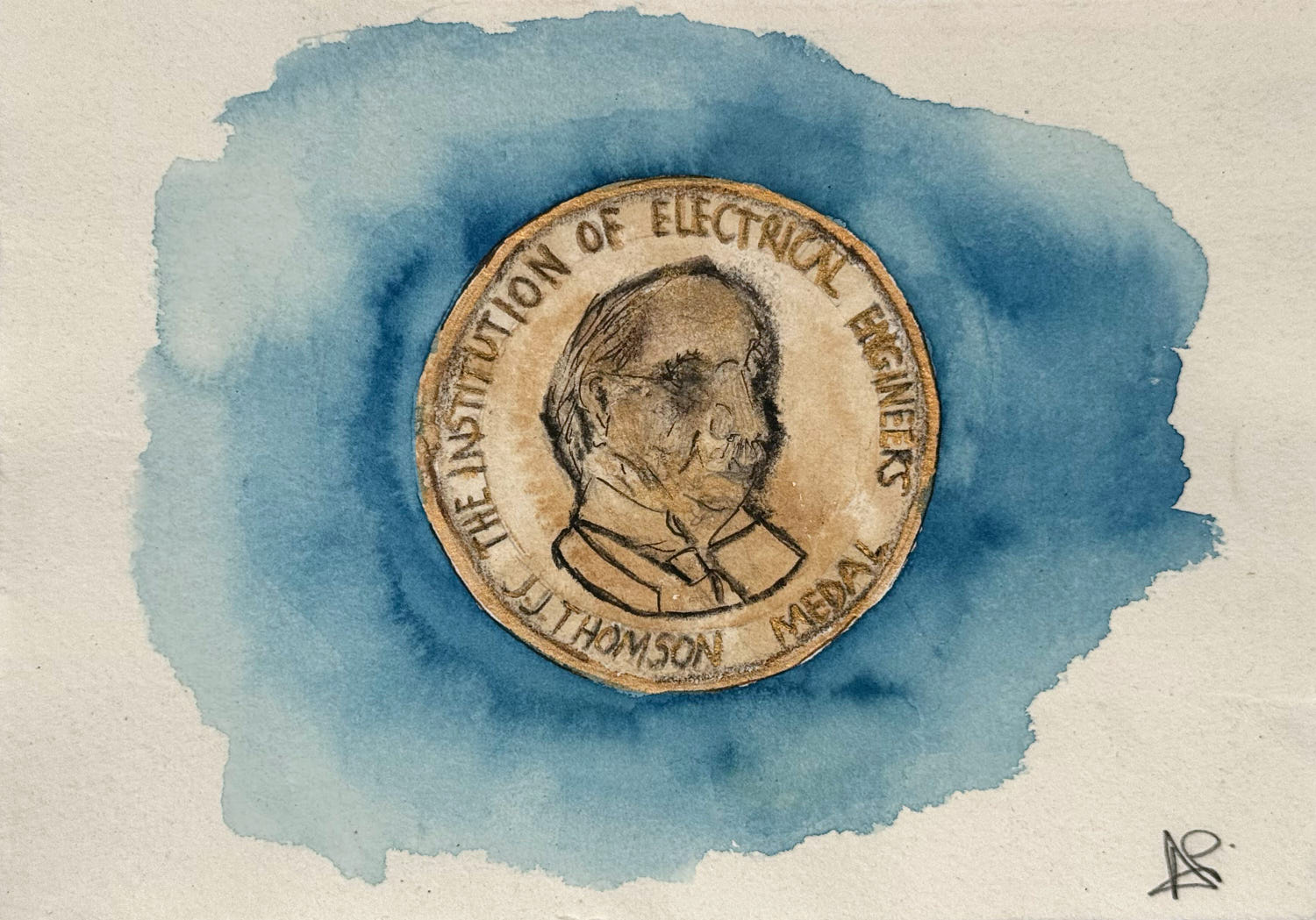
- Watercolour of Institution of Engineering and Technology (IET) JJ Thomson medal in the collection of the Flowers family. The IET also has the Tommy Flowers Room at their London headquarters.
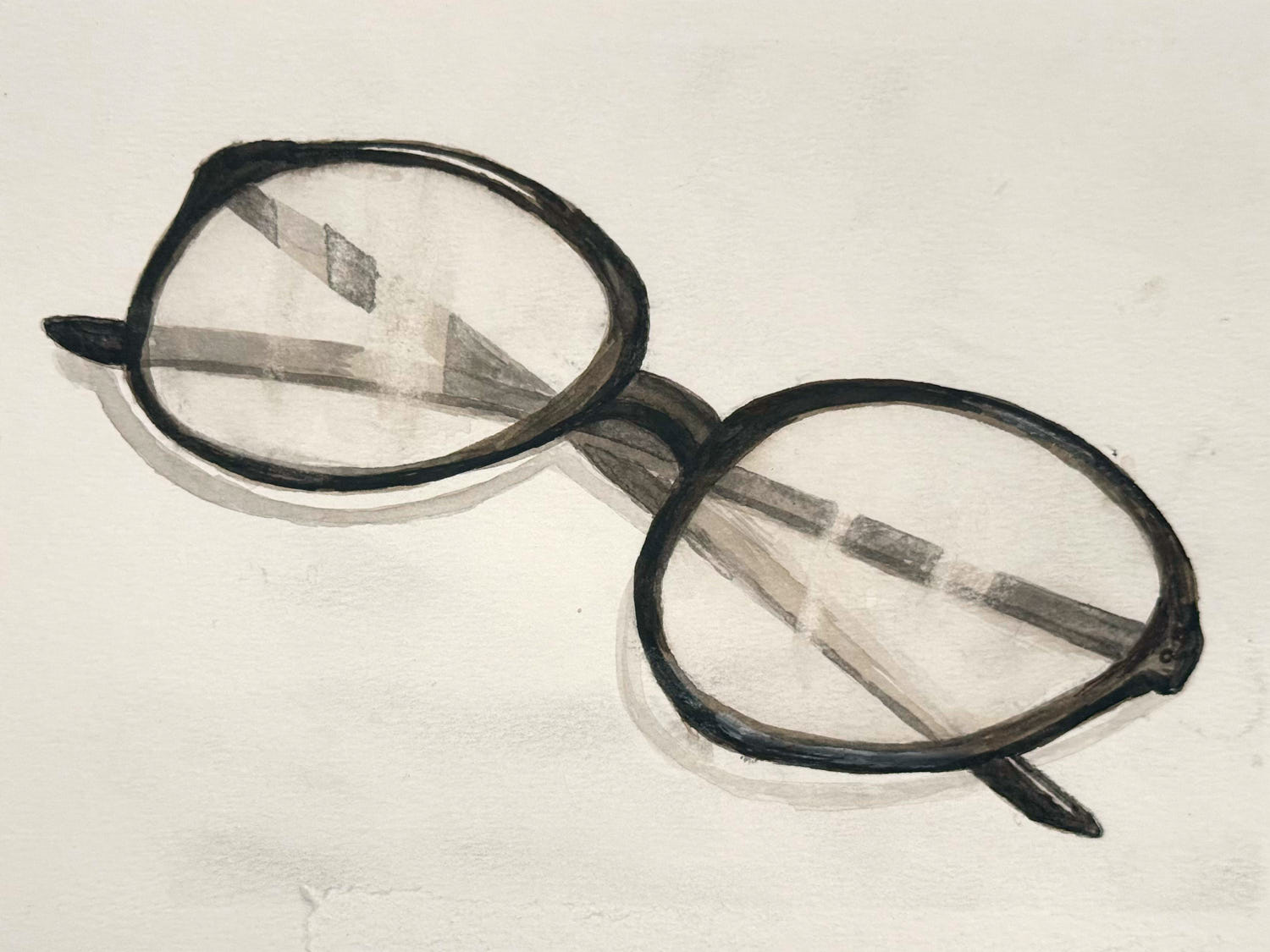
- Watercolour of spectacles worn by Tommy in the 1940s, that are such a part of his character – and this Foundation’s logo.
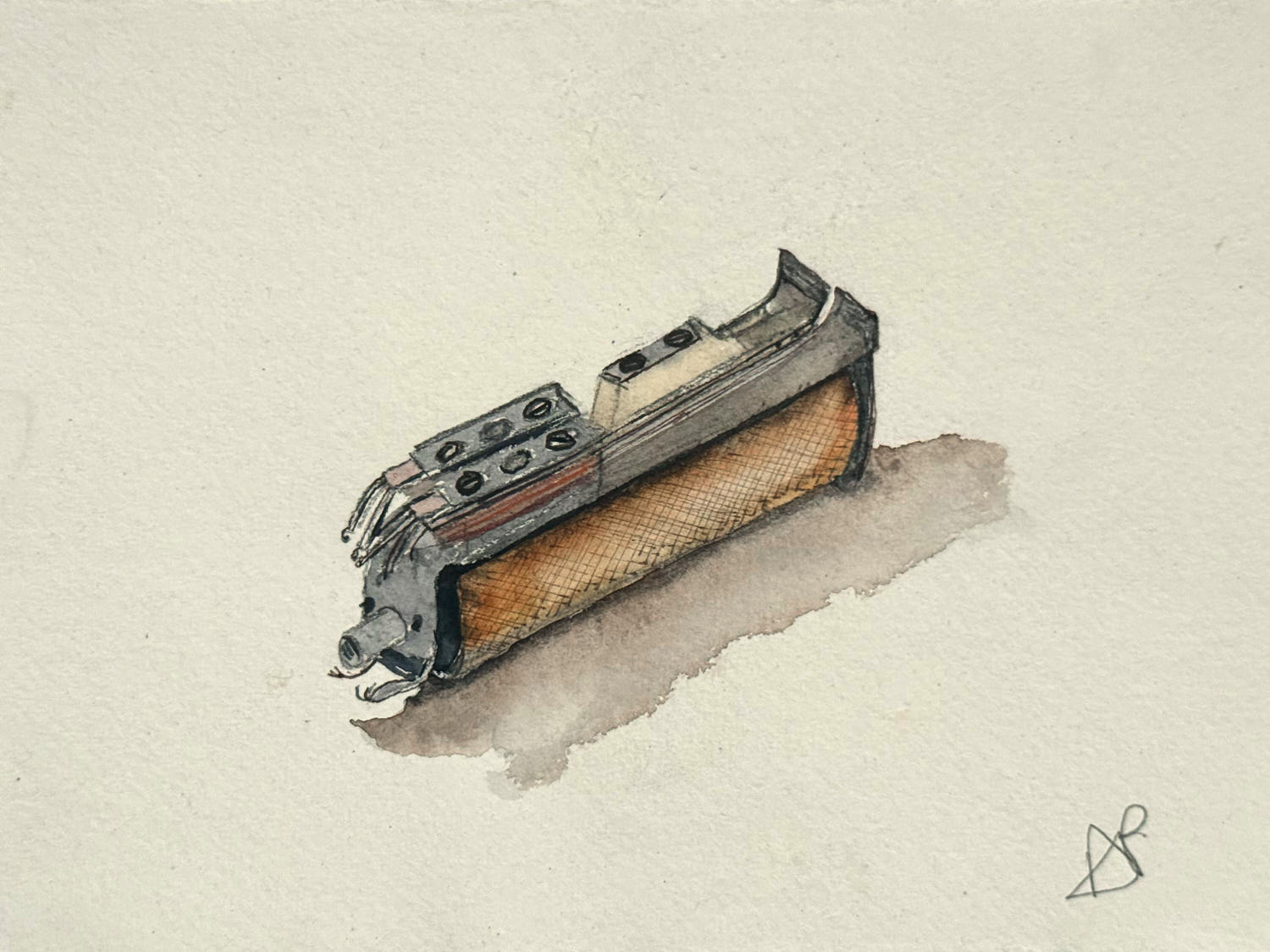
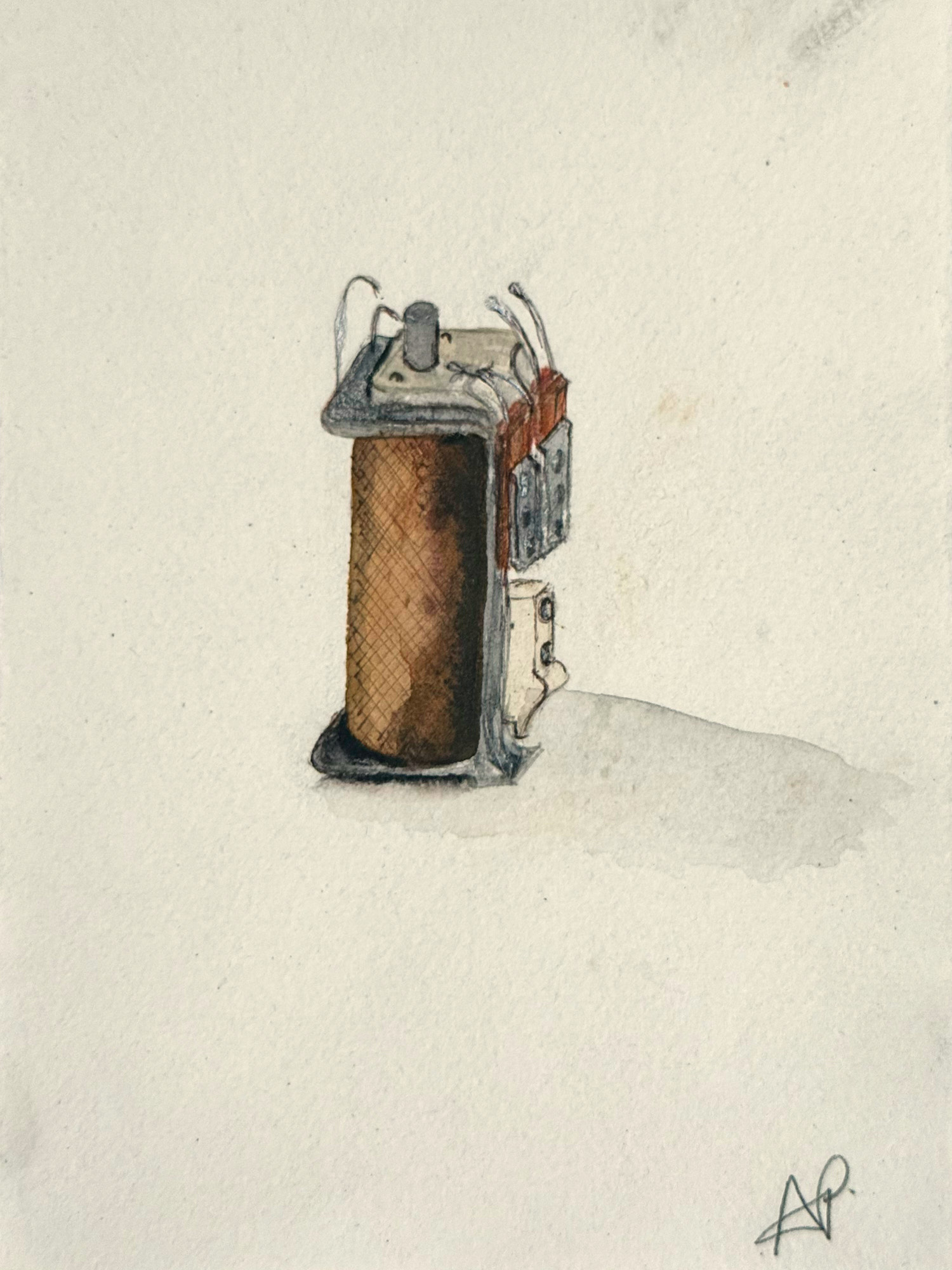
- Watercolour of mid-20th century GPO switching equipment repurposed for Colossus, a copper-wound relay switch.
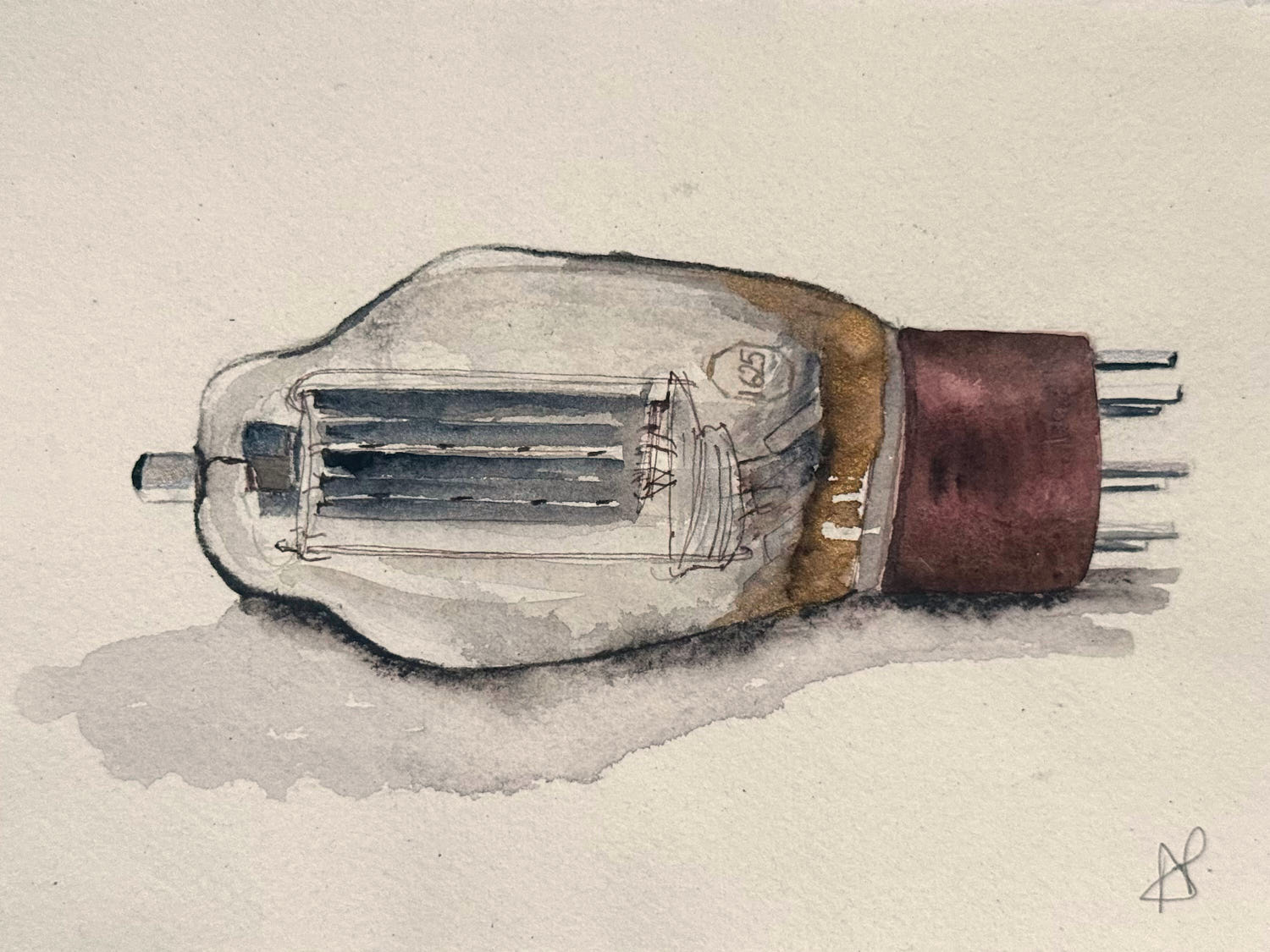
- Watercolour of GPO mid-20th century valve as used on Colossus.
- Mixed media, watercolour, pencil shavings on layered paper, of Lorenz machine coding wheels.
- Watercolour of one of the 2000 valves from Colossus in the Rebuild Room, National Museum of Computing (TNMOC) at Bletchley Park.
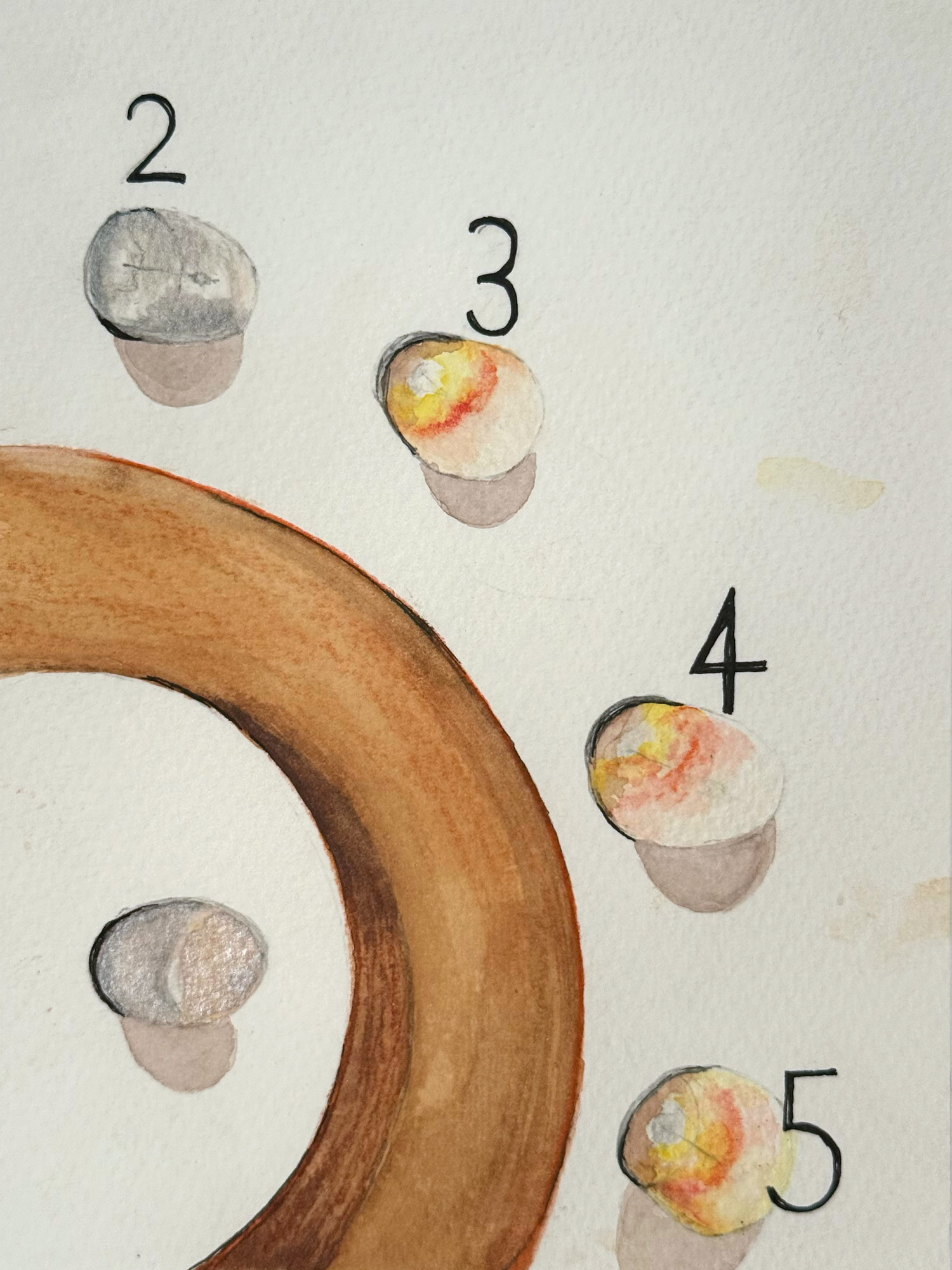
- Watercolour detail of E.R.N.I.E. (Electronic Random Number Identification Equipment), the first National Lottery computer built for UK Premium Bonds in 1956, now on display at The National Museum of Computing (TNMOC).
With thanks to Jo Flowers for access to the family archive and Jacqui Garrad and her team at TNMOC for ongoing support.